
Network programming is an essential concept in modern software development, enabling communication between different systems over a network. From web applications and chat systems to file transfers and APIs, network programming forms the backbone of connected applications.
Python, with its simplicity and powerful standard libraries, is widely used for network programming. It provides built-in modules like socket that make it easy to create applications that communicate over TCP/IP networks.
In this blog, we will explore the basics of Python network programming, socket communication, and real-world use cases.
What is Network Programming?
Network programming refers to writing programs that allow communication between two or more devices over a network such as the internet or a local network. These programs typically follow a client-server architecture where:
- The client requests data or services
- The server responds to those requests
Python makes it easy to implement both client and server-side applications using its networking libraries.
Why Use Python for Network Programming?
Python is a popular choice for network programming because:
- Simple and readable syntax
- Built-in networking modules
- Cross-platform support
- Rapid development capabilities
- Strong community and documentation
These features allow developers to quickly build and test network-based applications without complex setup.
Introduction to Socket Programming
Socket programming is the foundation of network communication in Python. A socket is an endpoint that allows two systems to communicate over a network.
Sockets work using protocols such as:
- TCP (Transmission Control Protocol): Reliable, connection-oriented communication
- UDP (User Datagram Protocol): Faster but less reliable communication
Python’s socket module provides the tools needed to create and manage these connections.
Basic Client-Server Model
In network programming, the client-server model is commonly used:
- The server waits for incoming connections
- The client connects to the server and sends requests
This model is used in web servers, chat applications, email systems, and more.
Creating a Simple Server in Python
Creating a Simple Client in Python
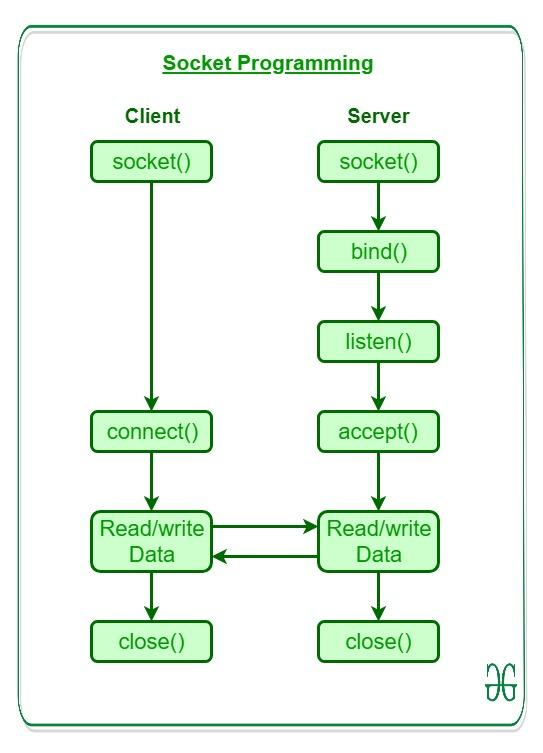
How Socket Communication Works
The process of communication involves:
- Server creates a socket and listens for connections
- Client connects to the server using IP address and port number
- Data is sent and received using send/receive methods
- Connection is closed after communication is complete
This simple mechanism allows systems to exchange data efficiently.
Real-World Use Cases of Python Network Programming
Python network programming is used in many practical applications:
1. Web Servers and APIs
Python frameworks like Flask and Django use network programming concepts to handle HTTP requests and responses.
2. Chat Applications
Real-time messaging apps use sockets to enable communication between users instantly.
3. File Transfer Systems
Applications that transfer files between systems rely on network communication protocols.
4. Network Monitoring Tools
Python scripts can monitor network traffic, detect issues, and analyze performance.
5. Distributed Systems
Large-scale systems use network programming to communicate between multiple servers and services.
Advanced Concepts in Network Programming
Once you understand the basics, you can explore advanced topics such as:
- Multithreaded servers for handling multiple clients
- Asynchronous programming using
asyncio - Secure communication using SSL/TLS
- Handling large-scale distributed systems
- Building REST APIs using HTTP protocols
These concepts are widely used in modern backend development.
Best Practices for Network Programming
To write efficient network programs:
- Always handle exceptions and errors
- Close connections properly to avoid resource leaks
- Use appropriate protocols (TCP vs UDP) based on requirements
- Optimize data transfer for performance
- Secure communication using encryption where needed
Following these practices ensures reliable and secure applications.
Python network programming is a powerful way to build applications that communicate over networks. With its simple syntax and built-in socket library, Python allows developers to easily create client-server systems, chat applications, APIs, and more.
Understanding the basics of socket programming is the first step toward mastering network-based applications. As you progress, you can explore advanced networking concepts and build scalable, real-world systems.
Python continues to be a valuable tool for developers working in networking, backend development, and distributed systems, making it an essential skill in today’s connected world.
For More Information and Updates, Connect With Us
- Name Sumit singh
- Phone Number: +91 9264477176
- Email ID: emancipationedutech@gmail.com
- Our Platforms:
- Digilearn Cloud
- Live Emancipation
- Follow Us on Social Media:
- Instagram – Emancipation
- Facebook – Emancipation
Stay connected and keep learning with Python Training !